Signed Off Is Not Learned
Every name on your training sheet is signed, and the step everyone learned still goes wrong. This week, watch one person demonstrate that step safely and write down where they stop.

The sheet says they know it
Picture a floor supervisor with a binder of signed training sheets. Every name is there. Every box is checked. Then the crew switches from one product to another on a Tuesday, and the job goes wrong, on the one step everybody was “trained” on.
The sheet was never wrong. It recorded what it can record: a person sat in a room. It cannot record whether they can do the step alone, tired, at 2 a.m., with the line waiting.
Put short: a class ends, the job does not. And the same gap shows up in every house, school and team.
Why a good class feels like it worked
Here is the fact that explains the whole problem.
In 2006, Henry Roediger and Jeffrey Karpicke ran a study on memory (Psychological Science, “Test-Enhanced Learning”). Students read short passages. Some reread them again and again. Others had one study period and then tried to recall the passages from a blank page. Five minutes later, the rereaders did better. One week later, it flipped. In one group the students who studied four times recalled about 40 percent of the ideas. The group that studied once and was tested three times recalled about 61 percent. The rereaders also felt more sure they would remember.
Read that last part twice. The people who learned less felt better about it.
That is the trap in every training room. Watching someone demonstrate a step, nodding along, and seeing it again feels like learning. It is familiarity. The test of learning is whether you can pull it out cold, later, with nobody feeding you the answer.
A second piece of research points the same way. Ebbinghaus measured forgetting in 1880, and Jaap Murre and Joeri Dros replicated his curve in 2015 (PLOS ONE). The pattern held: a lot is lost early, and the loss slows after. The researchers measured how much study time was saved when one person relearned lists of nonsense syllables. That does not tell us the cost of a missed step at work or the best day to check it. The practical move is to check again after time has passed, while a gap can still be caught safely.
The mistake
We treat the event as the finish line. The class happened, the sheet is signed, the box is closed. Then we blame the person when the step fails: “I showed them.” Showing is not the same as them being able to do it.
It costs more than a bad changeover. It teaches people that training is paperwork, so they stop taking it seriously. And it hides the real signal. If four people slip on the same step, look for something they share: the teaching, the instructions or the setup. A repeated miss is a reason to investigate, not proof of one cause.
Aristotle had this one a long time ago: we learn the things we must do by doing them. A class starts a skill. The doing finishes it.
Same move, other rooms
The same move works outside the plant.
A kitchen. Picture a head cook who walks a new hire through the allergen check on Monday. On Wednesday the head cook watches the new hire show the check on a practice order, without prompting. A correct demonstration shows what the person can do that day. It still needs a later check. If there is a gap, the lesson goes back to the step, not the person. Required food safety checks stay in place.
A classroom. Picture a teacher who ends Friday with a blank page: “Write down what we did Tuesday.” No grade. It tells the teacher what stuck, and the act of writing helps it stick.
A hospital wing. Picture a charge nurse who asks a new nurse to say out loud the steps for a procedure the next shift, before doing it. Not a quiz to catch anyone. A habit that makes the gap visible while it is still cheap.
A home. Picture a parent who taught a kid to use the stove. A week later, the parent says, “Show me how you’d do it.” Same idea. Ask for the doing, not “do you remember?”
One sign-off, followed all the way
Here is the whole method on one step, start to finish.
Monday. A new operator, call them Sam, finishes a class on the changeover checklist for a filling line. The sheet gets signed. In the old way, that is the end.
Tuesday. The lead picks a low-risk point in the changeover, the label and lot code check, where a mistake gets caught before anything ships. The lead says, “I am checking my teaching, not you,” and asks Sam to walk through it on the line while the lead watches. No coaching. Sam gets the label right and skips the lot code. Nothing is hurt and nothing ships, so the lead lets the step play out, then stops and shows the gap. If the miss had been on a guard or a lockout, the lead would have stopped Sam on the spot.
The lead does not write “Sam missed it.” The lead writes “lot code step missed on first check” on the training sheet, then looks at the class notes. The lot code is on page three, after the break. That is a teaching gap, not a Sam gap.
Wednesday. Sam does the changeover again with the lead watching. This time it is right. The lead puts a second check on the calendar for the next Tuesday, with no warning to study.
The next Tuesday. Sam does it cold, a week out, with the lead watching, and gets it right. Now the sheet means something. The lead signs the third line: “Shown without prompting, one week later.”
Then the part most leads skip. Two other new operators trained that month also miss the lot code on their first check. Three people, same step. The lead keeps the required checks and fixes the class: the lot code moves to the front of the checklist and gets its own line on the job aid at the machine. The next new hire gets it right the first time.
If Sam had missed it again on the second check, the answer would not be a warning. It would be one more supervised practice, a third check, and a hard look at whether the step was taught or only shown.
Change what the sheet asks for
Most training sheets have one line: trained, with a date and a signature. That line is honest about the class and silent about the skill. You do not need a new system to fix it. You need two more lines on the sheet you already use.
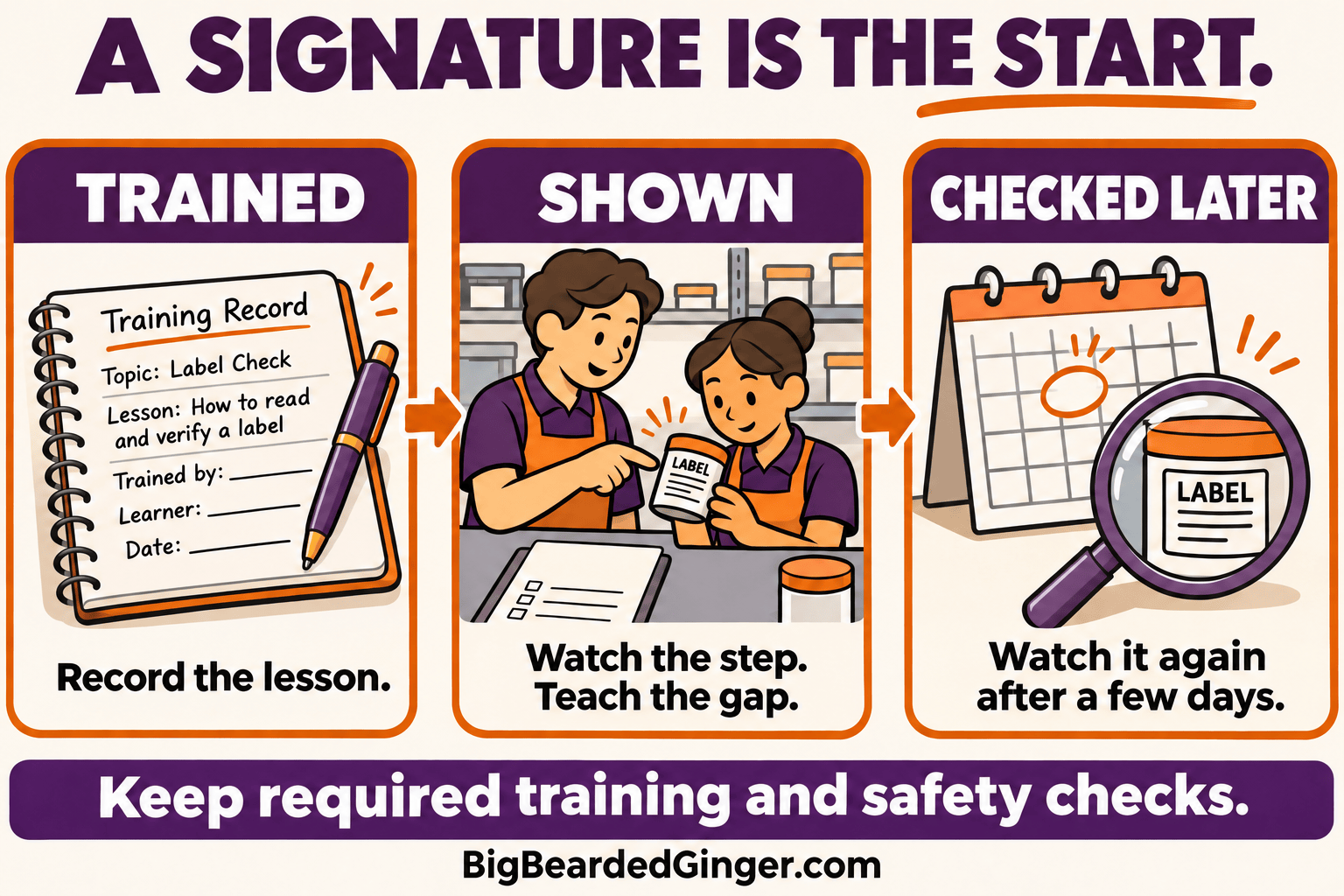
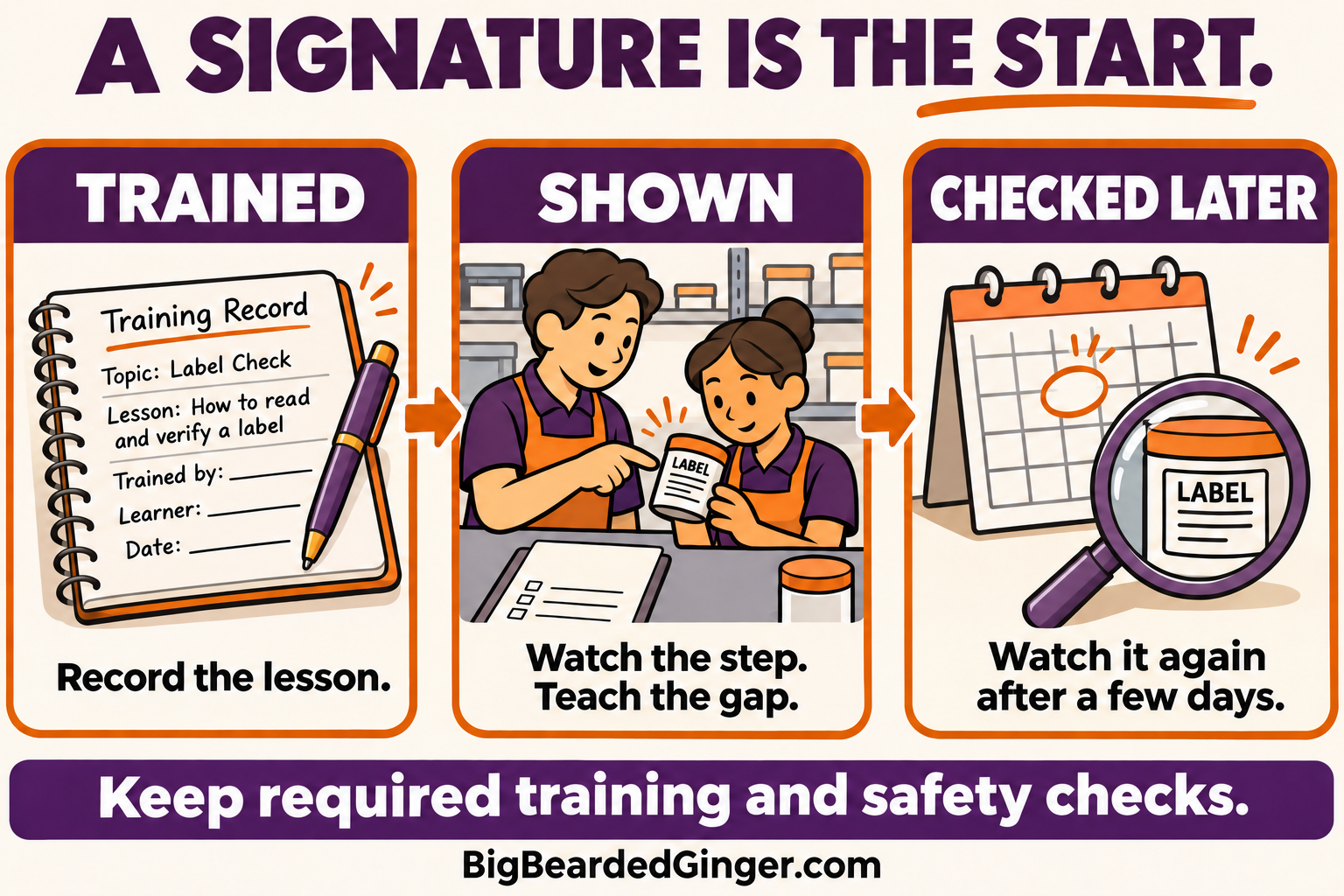
Trained. The class date and who taught it. This is the line you have now.
Shown. The first time the person did the step on the job, with the lead watching, and what, if anything, was missed. Write the miss as a step, never as a grade on the person.
Shown without prompting, later. A check at least a few days after the first one, without a last-minute rehearsal. Use a low-risk step or approved practice setup, with the lead watching. Record the step demonstrated and any gap. This is evidence of that performance, not a blanket qualification.
Keep required training, qualifications, supervision and safety checks. The third line does not replace them. The learning follow-up stays open until that later check is recorded. A sheet with a lot of first lines and very few third lines is not a training record. It is a to-do list, and now you can see it. Read the misses across the whole sheet once a month. When the same step shows up three times, fix the class, not the people.
How the check goes wrong
It becomes a gotcha. If the check feels like a trap, people hide the gaps. Say it first: “I am checking my teaching, not you.”
You help too soon. If you hand over the answer, you test your own memory. Give the person time to think when it is safe. Stop and help at once if an error could cause harm.
You check once and call it done. The first check catches the loud failures. A second, later, catches the slow ones.
You check only the people who struggle. Then the check is a punishment. Check everyone, the sharp ones too.
For someone who has heard this
If you already run checks, ask a harder question: does the check use the same words as the class? Then you are testing recognition. Change the setup. Ask for the step on another machine or setup the person is already cleared to run, or on a slightly different problem. That is where a skill shows up or does not.
Leading yourself when nobody is watching
You have learned things in your own life and never checked them. A safety rule you read once. A way to handle a hard conversation. A budget habit. Pick one. Close the notes. Write the steps from memory, then compare. The gap you find is the lesson you only thought you had.
Do this tomorrow
Pick one person trained in the last two weeks on one step. Choose a low-risk step or an approved practice setup. Watch the person demonstrate it. Stop and help if an error could hurt someone or damage equipment. Then teach the gap and schedule a second supervised check a week out. After, ask: “What part felt shaky?” Write it down, and fix the teaching if the same thing shows up twice.
Go deeper: A Skill Matrix Should Tell You Who Can Do the Work and the free White Belt course.
Sources: Roediger, H. L., and Karpicke, J. D. (2006), “Test-Enhanced Learning: Taking Memory Tests Improves Long-Term Retention,” Psychological Science. Murre, J. M. J., and Dros, J. (2015), “Replication and Analysis of Ebbinghaus’ Forgetting Curve,” PLOS ONE. Aristotle, Nicomachean Ethics, Book II. The research is about memory for material studied. The filling line, kitchen, classroom, hospital wing and home show where the idea applies; they are not proof.
Marc Bradburry · bigbeardedginger.com/signed-off-is-not-learned/